Chapter 32: Expansion
Before upgrading her Safe City to Tier 3, Cheng Qisheng had always been curious about one question.
Every time a Safe City advanced a tier, its land area doubled.
But did that doubling include the extra territory gained by devouring another Safe City’s core?
At present, none of the city lords in the zombie world could answer that question for her.
Blue Leaf explained it this way:
“Under normal circumstances, wars only start voluntarily once a Safe City reaches Tier 3.”
Before Tier 3, wars were basically forced upon you.
In other words: someone had decided you looked like an easy target.
Either you got lucky and escaped disaster, or you were defeated and had your core devoured.
As for someone like Cheng Qisheng—who had just reached Tier 2, fought a Tier 3 city lord, and actually won—that was an exceptionally rare case.
Cheng Qisheng considered herself very fortunate.
After interacting with other city lords, she realized that, let alone Tier 3, most city lords who managed to reach Tier 2 were cautious survivalists who preferred to keep a low profile.
A type like Cosmic—someone with little ability who still took the initiative to provoke others and practically delivered his core to her doorstep—how lucky did she have to be to run into one of those?
In any case, nobody could give Cheng Qisheng an answer. Even Coriander, who was usually well-informed, and Aether, who knew a great deal about high-tier information, had no idea whether territory acquired from other Safe Cities would also double upon advancement.
She could only test it herself.
The answer was: No.
Before upgrading, Blue Sea Safe City’s actual area was:
Tier 2 Blue Sea (1,600 km²) + Cosmic Lord Safe City (4,800 km²) = 6,400 km²
After the upgrade, Blue Sea’s actual area became:
Tier 3 Blue Sea (3,200 km²) + 4,800 km² = 8,000 km²
Cheng Qisheng was a little disappointed, but the more she thought about it, the more reasonable it seemed.
If advancing a tier doubled not only your original territory but also all the land you had absorbed from other Safe Cities, then the city lord group chat wouldn’t still maintain even this superficial peace.
Who would bother hunting zombies for crystal cores?
Everyone would just focus on killing each other.
Obtaining another city’s Safe City Core was far more profitable than painstakingly saving up crystal cores.
For Blue Sea Safe City, the most important benefit of this upgrade was the opportunity to take advantage of the expansion and redesign the city.
The first major project was the floating roads that had amazed countless Blue Sea residents who hadn’t returned home for some time.
They actually had a proper name:
The Three-Dimensional Transportation Network.
Its purpose was simple:
As a general rule, people would no longer walk on the ground in Blue Sea.
If you needed to travel, you’d do it in the sky.
This would make much more efficient use of the city’s land area. Whether for residential buildings or factories, a vast amount of space would be freed up.
For Cheng Qisheng, all she had to do during the upgrade was click a few buttons on the blueprint.
For Aether and Blue Sea’s Urban Planning Department, however, both the staff and the AI systems had been so busy during this period that they barely had any free time.
For the Three-Dimensional Transportation Network to function properly, it required more than just elevated roads in the sky. It also needed elevators and stairways connecting those roads to the ground.
To minimize traffic accidents and improve travel efficiency, most of the routes were designed as one-way roads. However, some areas were unsuitable for one-way traffic and required special planning.
Load-bearing capacity, structural stress, connection points—calculating these factors alone was enough to keep the Urban Planning Department overwhelmed.
And that was before even considering the more complicated transfer stations, distribution hubs, and multi-level layouts.
This was different from the previous resident-flow planning.
Back then, the goal had been to encourage residents to cross paths and interact.
Now, the goal was to allow residents to reach their destinations quickly and accurately.
After all, most of the roads on the ground had been dismantled. The aerial road network therefore needed much finer classification and organization.
Otherwise, situations could arise where residents became stranded on elevated roads, unable to go up or down—which would be extremely awkward.
Passenger flow, vehicle traffic, cargo transport, peak hours, off-peak hours, and even the distribution of various ground-level districts all had to be carefully calculated.
A change at a single station could potentially force revisions to the entire blueprint.
Fortunately, they had Aether, the super-intelligent AI. Once it joined the calculations, the Urban Planning Department’s workload dropped dramatically—from having no time to sleep at all to averaging more than three hours of sleep per person.
To show its support, the government even supplied the department with additional coffee machines and Starfruit Vegetables.
As a result, everyone transitioned from unhealthy all-night work sessions to healthy all-night work sessions supplemented with nutrition.
Compared to the humans, who at least needed some sleep, Aether never rested for even a single second.
When Cheng Qisheng was asleep, it was in front of virtual screens calculating coordinates and positioning data.
When Cheng Qisheng was eating, it was crouched beside her bowl planning transportation routes.
When Cheng Qisheng was chatting in the city lord group chat, it was attending meetings with designers.
It became so busy that Cheng Qisheng started wondering whether she was exploiting Aether a little too much and asked if it needed a break.
To her surprise, Aether seemed quite happy about it.
“Although the current workload is complicated, it has not yet reached the point where it would tire Aether. Being able to serve my City Lord makes Aether happy.”
Cheng Qisheng: All right. I officially declare you the hardest-working employee in Blue Sea.
And so, layer by layer, the floating roads took shape through sheer determination and effort.
Once the transportation network’s blueprint was completed, the Planning Department immediately began designing buildings to match it.
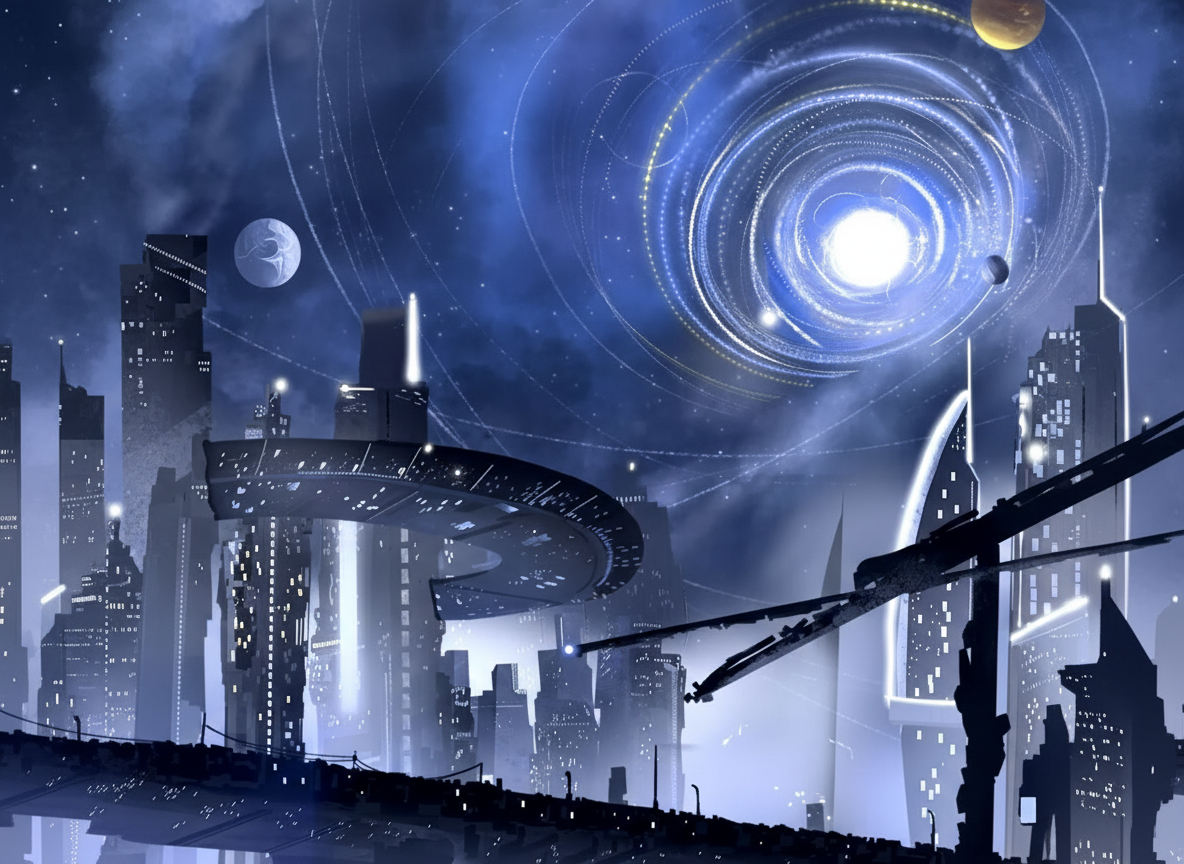
These were the towering skyscrapers that returning Blue Sea residents were now seeing.
“Are these really our old apartment buildings? I can barely recognize them.”
Following guidance automatically sent by the city’s AI system, a team of crystal-core hunters entered through Gate A12, boarded Bus Route B32, transferred at Station C142, and eventually arrived on the 52nd level of the floating transportation network.
Throughout the entire journey, they kept the local survivor they had rescued with them instead of sending him to the outer city.
Because—
he was a doctor.
Blue Sea only accepted believers as official residents. However, in any era, possessing valuable skills and lacking them were two very different things.
For example, doctors were exceptionally valuable talents in an apocalyptic world.
If crystal hunters managed to bring back someone like that, and after verification it was confirmed that the person genuinely possessed the claimed skills, the residents who brought them back would receive contribution-point rewards.
That was exactly what they were doing now—taking the doctor to the temple, where his skills would be verified.
The local doctor sat obediently in his seat with his seatbelt fastened and cautiously asked the local translator:
“This city is so huge. Aren’t you worried that I’ll run away?”
After seeing the magnificent Safe City, the large number of residents coming and going, and the strict quarantine procedures, he had assumed that outsiders like himself would be gathered in a designated area, have their skills assessed, and then be sent to the outer city.
“I already know the inner city has much better conditions. Yet you’re bringing me into the inner city right now. If I quietly slip away, couldn’t I just blend in and stay here?”
Looking at the city’s complex architecture and winding transportation network, an ordinary person seemed no more noticeable than a drop of water falling into the ocean.
If he ran off, where would they even begin looking for him?
The translator replied:
“You don’t have a resident ID. You can’t run.”
“Oh…” The doctor nodded in understanding. “So only people with resident IDs can exchange for food and access housing?”
Military-style management? In an apocalypse, that seemed fairly normal.
The translator nodded, then shook his head.
“It’s true that you need a resident ID to eat at the cafeterias. But that’s not the main issue.”
“The main issue is that without a resident ID, you’re under heavy surveillance.”
As he spoke, he pointed outside.
Instinctively, the doctor followed the direction of his finger.
He saw that along both sides of the roadway, almost every stretch of road had two drones with blinking red lights, monitoring the movement of vehicles.
“Are those surveillance cameras?”
Even before entering the city, the doctor had noticed countless drones flying in and out of Blue Sea. They all seemed extremely busy.
The translator replied, “Those are the AI’s eyes.”
“You saw how we received text messages as soon as we entered the city, right? Those route instructions were sent by the AI. Almost every resident gets different directions. Each of us has a personalized travel route within the city to prevent traffic congestion.”
He patted the doctor on the shoulder.
“Since you’re not a resident, the moment you entered the city, you became a priority observation target for the AI. The drones flying overhead and the surveillance systems everywhere are all watching you. If you do anything suspicious, they’ll react immediately.”
The doctor hesitated.
“…Why does that sound like the beginning of a horror story? If I do something suspicious, will the police show up and arrest me right away?”
The translator shook his head.
“Look at those drones outside. Take a closer look.”
The doctor narrowed his eyes and looked carefully.
Then he noticed that beneath the drones—which he had assumed were only there to monitor traffic safety—
guns were mounted underneath them.
Doctor: “…”
He immediately stopped looking around and sat back down obediently.
Seeing that the doctor had finally settled down, the translator secretly breathed a sigh of relief.
He himself was not yet a full resident either. He was a worker holding a temporary resident permit, which allowed him to move around the inner city.
His ultimate goal was to become an inner-city resident—a true citizen of Blue Sea.
Because of that, he was one of the people least willing to see his fellow countrymen cause trouble in Blue Sea.
The captain of the crystal hunting team he had joined was a former soldier. During casual conversations, the captain had once told him about the first survivor the Blue Sea people encountered on Velvet Star.
It had been a little girl hidden in a cellar by her mother.
To protect her daughter, the mother had tied herself up when she realized she was about to turn into a zombie.
She had even smashed out her own teeth.
This became Blue Sea’s first impression of the people of Velvet Star.
From their very first encounter, they had felt that the people of Velvet Star, like themselves, possessed tremendous courage and a profound capacity for familial love.
That initial impression had been an extraordinarily positive one.
In later encounters, Blue Sea gradually adopted a gentler attitude and began to accept more local survivors.
The translator felt genuine gratitude toward the mother of that little girl.
If Blue Sea’s first contact with the locals had been with a scumbag instead, no one could say what would have happened.
But one thing was certain: without Blue Sea rescuing him and accepting him, he would either have been bitten to death by zombies or starved to death.
So he had to take root in Blue Sea and become a true Blue Sea citizen.
And, he also had to keep an eye on other Velvet Star people—making sure they behaved, making sure they didn’t cause trouble, and making sure they didn’t give Blue Sea citizens a bad impression of the entire group.
Thinking this, the translator—who had originally been a bit sleepy from the journey—suddenly became alert. He stopped resting altogether, sat upright, and occasionally glanced at the doctor beside him, no longer even looking at the scenery outside.
Meanwhile, the crystal hunters were completely absorbed in what they were seeing.
After traveling at high speed along the 52nd-level road for 25 minutes, the bus transferred onto a slower route.
This road ran almost flush against the residential buildings. Each stop was also an aerial station directly connected to the buildings.
The hunters sat in their seats, looking out the window.
Below them, they could see layers upon layers of circular roads, crowds at city gates that looked like tiny ants, and the distant landscape of the sprawling settlement.
Now that they were closer to the residential districts, they could see that every floor of the high-rise buildings had two extended aerial walkways projecting outward.
Yes—every single floor of every building had its own aerial parking point.
Vehicles would stop directly beside these walkways, just like airplanes docking at a runway.
A voice chimed in: “Beep—Arrived at D79 Residential Zone, Building 176, Floors 81–89—”
The bus slowly came to a stop and announced the destination. The crystal-core hunters watched as two young women stepped off the vehicle, their eyes filled with curiosity and anticipation.
Once they delivered the doctor to the temple, they would finally be able to return to their own residence.
They were extremely curious—what would the residential areas look like now?
“I wonder what it looks like inside now. I’m kind of looking forward to it.”
Wang Moning and Song Xi got off the bus, chatting and laughing as they walked along the aerial road back toward the building.
“After these past few days of climbing up and down on chains, I’ve actually gotten used to it. Now that it suddenly switches back to modern life, I feel a weird sense of loss.”
That was Wang Moning speaking. She had only just adapted to the Blue Sea residents’ chain-swinging way of getting around.
And yet, after just one trip outside the city—
The once round, cement-style residential building had turned into a modern high-rise complex.
The two of them talked as they reached the end of the walkway.
The door was wide open.
From there, they could clearly see cave-like rooms, hanging chains, and residents climbing up and down everywhere.
Wang Moning: “?”
She turned back to look at the modern-style exterior of the building, then looked again at the cave-like interior.
Cheng Qisheng, who was quietly observing the believers: =v=
No helping it—most of the construction materials had been used for the floating transportation network. The remaining resources had gone into building the aerial walkways that needed to connect directly to the roads.
She wasn’t building skyscrapers.
She was constructing the buildings in the appearance of high-rise structures precisely so they could interface with the aerial transport network.
Hadn’t they noticed? The glass exterior walls of the buildings were constantly displaying station information in real time.
Of course, after the Safe City advanced a tier, it wasn’t as if living conditions wouldn’t improve at all.
Their “caves,” which originally could barely fit a few people standing inside, had now been expanded to 15 square meters.
Wang Moning and Song Xi returned to their own cave-like rooms and immediately noticed the change in size.
Not only that—the windows had been enlarged, glass had been installed throughout, and ventilation systems had been added. Overall comfort had increased dramatically.
The two of them, who had just been confused a moment ago, quickly realized that the redesign had clearly taken lighting into account. Their rooms were now bright during the day, filled with sunlight. After experiencing that warmth, they immediately accepted the changes with delight.
Although they hadn’t instantly stepped into a modern lifestyle, their living conditions had undeniably improved.
In the apocalypse, having a safe, well-lit 15-square-meter living space—what reason was there not to be happy?
Meanwhile—
The doctor, who had already accepted that this was not a cult but an alien city, finally arrived at the temple.
He looked up at the magnificent structure, the statue of the Creator God.
And at the white-robed high priests, who stood in reverent devotion, heads bowed in fervent prayer toward the deity’s statue.
He slowly processed what he was seeing.
“You’re telling me… this is a hospital??”
Take it or leave it, doc. Even I’m amazed at how much of a grip she has over her people to devote themselves like that.
Hey, to be fair, in fantasy settings, the church indeed moonlight as healers using their divine blessings.